Walmart's latest quarterly report reveals a phenomenal transformation of the retail business model. The world's largest player is shifting from earning its money on groceries, to becoming an advertising machine.
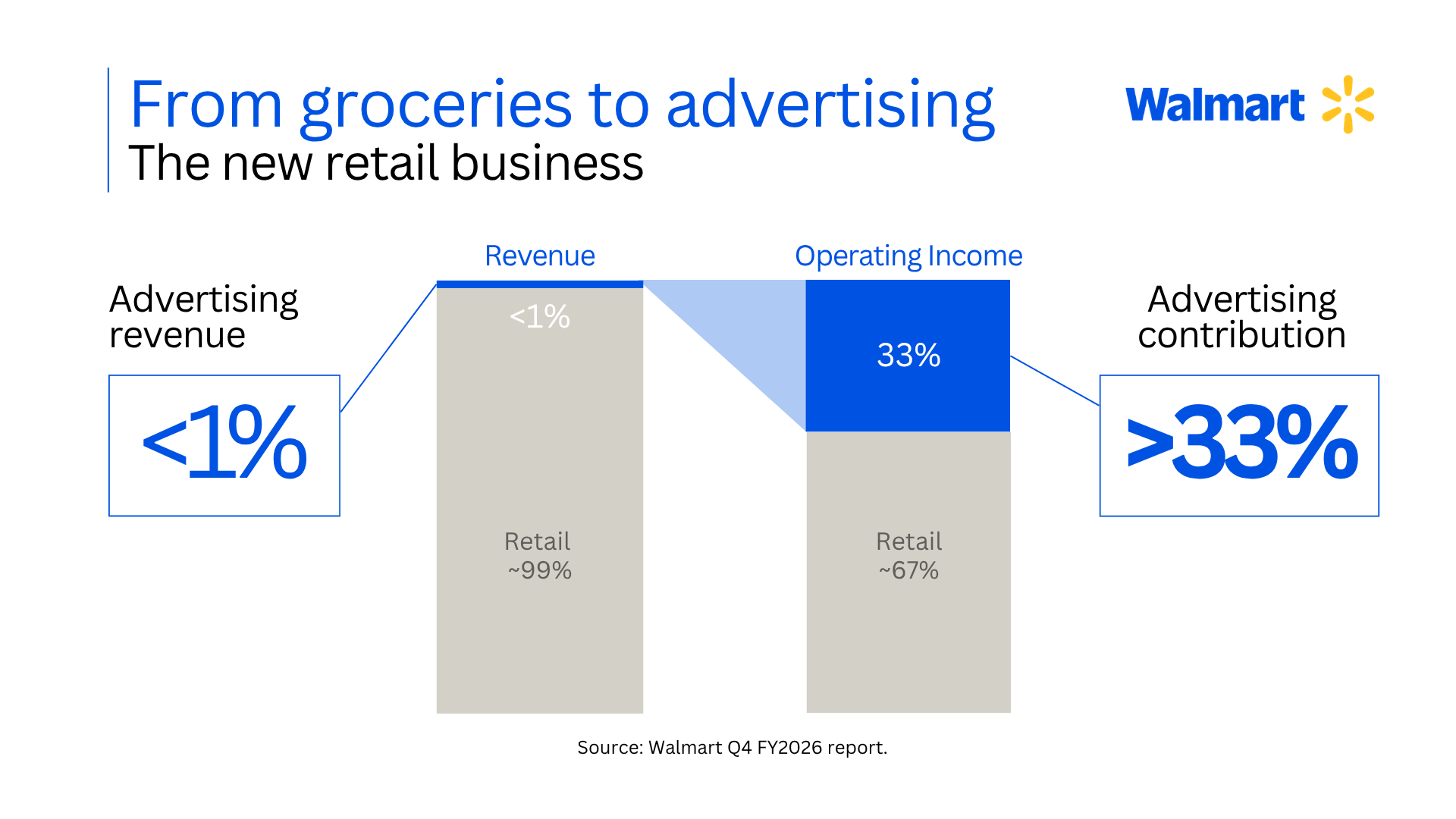
Their data reflects a model where the product generates almost no margin, because the new function of the inventory is to attract and retain shoppers, monetize their attention and sell it to brands, at a much higher margin:
Advertising represents less than 1% of revenue, but more than 33% of the operating income.
The scale of the shift stands out when you compare revenue lines to margins. On the revenue side, advertising is a tiny fraction, but on the profit side, it is a structural element.
Margin and projected growth complete the picture behind that contrast. They explain why the advertising sliver converts into a third of the profit, and why the gap will keep widening.
| Metric | Value | Implication |
|---|---|---|
| Retail margin | ≈3% | Selling the product returns about three cents of profit per dollar |
| Digital advertising margin | ≈70–80% | $1 of ad revenue ≈ $20 of grocery revenue in profit |
| Advertising growth (FY2026) | +46% YoY | More than double Amazon's pace (22%) |
One of the smallest lines on the income statement has become one of the largest profit engines.
The new main asset not displayed in the balance sheet
Walmart's new moat asset is the habit of more than 250 million customer visits per week, and the transaction record that habit produces.
Google knows what people search for and Meta what they engage with, but Walmart records completed purchases across a majority of American households.
Because groceries reset every seven days, the signal refreshes itself with recency and frequency.
Sixty years of weekly shopping trips built a dataset no rival can replicate.
How their advertising system works: four channels
To monetize that data, the company has built four advertising channels:
- Sponsored search. Brands bid to appear when a shopper types a product query into the app. This reaches people at the moment of highest purchase intent, and it lets third-party sellers compete for visibility against household brands.
- Display advertising. Placements on Walmart.com and the app, plus campaigns on TikTok, Meta, and programmatic networks powered by Walmart's first-party data. Their goal is to redirect external demand back to its own platform.
- In-store media. Screens, checkout displays, and audio spots across 4,700 locations. A fixed cost of the retail business becomes a revenue-generating advertising surface.
- Connected TV. The $2.2B acquisition of VIZIO in December 2024 gave Walmart the operating system in millions of homes. It sells advertising there and then verifies whether an ad exposure led to a purchase in its stores or on its site.
Four ad products, of which most competitors operate just one or two. The unique part is that Walmart's four channels see the same person.
A campaign can start on the VIZIO screen at home, continue as sponsored search in the app, and close on a display next to the shelf.
Every step writes into the same customer record, so each channel measures and improves the other three. Connecting an ad seen at home with a purchase completed days later is closed-loop measurement, and it only works when one company owns every step.
The advertising industry chased that omnichannel model for decades. Now Walmart is building it.
Now shoppers are the product, brands are the client, and the retailer is a platform
An interesting thought following the money flow suggests a shift in the roles in retail:
Procter & Gamble, Unilever, and thousands of marketplace sellers now pay Walmart for access to shoppers' attention and to the data that gets it. In that transaction, the brand is the client, and the shopper is the product it pays to acquire.
This is the business model of television and social media, moved into the supermarket.
Google and Meta built two of the world's most profitable companies by selling audience attention. Retail now applies the same economics to the aisle, the app, and the living room screen.
This audience needs to get compensated to return, so advertising income funds the merchandise price cuts that keep 250 million people coming back every week. Shoppers trade attention and data for cheaper groceries and technology.
As a result, product margins may keep shrinking.
The flywheel
The strategic strength of the model lies in how each side feeds the other. The result is a flywheel that reinforces at every cycle:
Every cycle makes the loop stronger, and increases the moat.
How is Walmart's version different than Amazon's and Costco's?
Separately, the pieces of this model were already proven. What is new is a company holding all of them at once:
- Amazon proved the advertising layer. Its $68B in annual ad revenue shows a retail platform can become one of the world's largest advertising businesses. Its purchase data, however, lives almost entirely online.
- Costco proved the profit-elsewhere layer. It sells products at near-zero margin and earns roughly half of its operating profit from membership fees. Its moat is member loyalty; data plays a small role in it.
Walmart is the first to combine both layers, digital and physical, in one loop. It sees the same customer in the store aisle, on the app, and on the VIZIO screen at home, and it records buying habits across all of them.
That is the sustainable moat they are trying to build. The depth and detail of purchase behavior across physical and digital channels is what maximum ad personalization requires, and no other company holds it at this scale.
Walmart remains a decade behind Amazon in advertising size, yet it grows at more than double Amazon's pace. Its ads have outgrown its own retail sales every quarter, and will continue to do so.
The broader perspective: latent data is becoming the main asset in the mixed digital and physical world
The relevance of this story extends well beyond retail. It shows how much value can sit dormant inside an established company, because every capability Walmart now monetizes was originally built for a different historical purpose:
- Stores built to sell products turned out to be an audience of weekly visitors.
- Checkout systems built to process payments now work as a measurement platform.
- Decades of customer relationships have become the trust that advertisers now pay to access.
None of these assets was designed for advertising, and yet all of them are now proving more valuable than any commercial strategy.
Walmart spent sixty years building them to defend a 3 percent margin. Now they monetize them at a much higher profitability, but to a new customer.
The assets that never appeared on their balance sheet now deliver a third of their profit.
Source: Walmart Q4 FY2026 report.