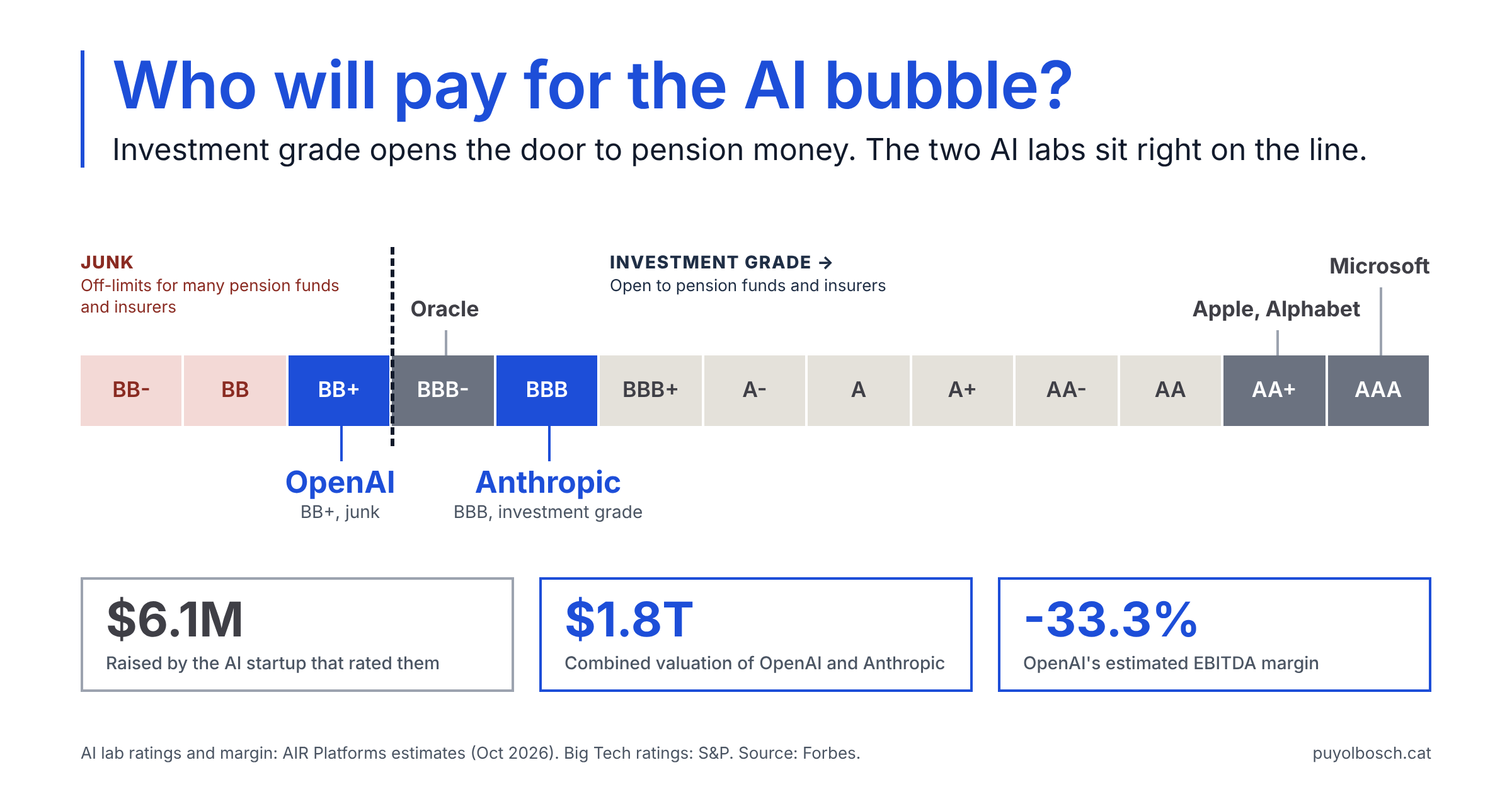
Every technological revolution has had its bubble, and every bubble has ended with someone paying the bill. A credit report published this month points to an uncomfortable possibility: our pensions might pay for the AI bubble.
Last week, Forbes reported on a ten-person startup in New York that rated the debt of the two leading AI labs. It used AI to fill the gaps in their public data. Its verdict: OpenAI's debt is junk, and Anthropic is barely investment grade.
A credit grade sounds technical, yet it decides something very human. Investment grade lets pension funds and insurers buy a company's bonds, and Wall Street is already pushing to secure it for both labs. If it succeeds, the savings of teachers, nurses and retirees will finance the AI buildout, and carry the losses if the bubble deflates.
An AI startup put the AI giants on the junk line
I laughed when I first read the story, and then I thought about my pension. The startup is AIR Platforms, and the scene could come from a satire about Silicon Valley, except that every detail is real:
- The judge runs on AI. AIR's model estimates the figures the labs keep private, and its analysts review the result. Both labs market their models to banks and investors as tools for exactly this kind of analysis.
- The size gap is extreme. AIR has raised $6.1 million. The two labs it rated are valued at about $1.8 trillion, roughly 300,000 times more.
- The verdict lands on the line. OpenAI came out one notch below investment grade, and Anthropic one notch above it.
- The labs stayed silent. Neither company shared its books with AIR or answered Forbes. AI filled the gaps that their own disclosure left open.
The joke has a serious edge. If ten people with AI can reach this view from public data, the pension funds asked to buy this debt deserve audited numbers.
Analysis powered by AI, the product both labs sell, put them on the junk line.
The numbers behind the grades
AIR is led by CEO Glenn Carvajal, who spent twelve years at Moody's. AI estimates the missing pieces from public data, and analysts can override any figure before the credit model scores the result.
| Measure | OpenAI | Anthropic | Big Tech benchmark |
|---|---|---|---|
| AIR rating | BB+ (junk) | BBB (investment grade) | Investment grade for six of seven firms, Oracle the exception |
| Estimated EBITDA margin | -33.3% | 5.4% | 43.3% (median) |
| Main driver | Losses large relative to revenue, limited interest coverage | Positive adjusted operating result, very high interest coverage | Established, cash-generating businesses |
The investment-grade floor is BBB-, so OpenAI sits one notch below it and Anthropic one notch above. AIR adds its own caution: Anthropic's grade rests on a single quarter of results. Co-founder Joe Burdis notes that small changes in the numbers can quickly shift the credit picture of a fast-growing company.
A registered agency was stricter. Kroll Bond Rating Agency assigned Anthropic a BB+ rating in June, one notch below investment grade, according to the Financial Times. The company had shared revenue and adjusted operating income, while free cash flow and EBITDA stayed undisclosed.
The labs' banks want a better grade. According to the Financial Times, Goldman Sachs and Morgan Stanley have asked S&P, Moody's and Fitch to rate both labs investment grade after their IPOs.
Both labs sit within one notch of the investment-grade floor.
The largest obligations sit off the balance sheet
On paper, both labs carry little debt. OpenAI reported no balance-sheet debt at the end of March, with more than $5 billion of credit lines available. Anthropic was finalizing a $15 billion revolving credit facility in September.
Most of the exposure sits in long-term contracts for chips, data centers and computing capacity. These contracts behave like debt, because the payments come due whether or not the revenue arrives.
| Obligation | Amount | Why it matters |
|---|---|---|
| Anthropic infrastructure commitments | At least $518B | About 80% cannot be cancelled, according to the draft prospectus reported by Reuters |
| Broadcom-linked equipment leases (part of Anthropic's total) | $161.2B | Largely noncancelable lease obligations for AI chips |
| OpenAI planned data center and chip spending to 2030 | $856B | Includes $100B of Amazon computing capacity over eight years |
| Nvidia guarantee on OpenAI's Ohio data center campus | Up to $105B | Ends if OpenAI earns a "satisfactory credit rating" |
Forbes notes that AIR's grades do not directly include these obligations, so the scores may be generous. How much weight a lease or a capacity contract deserves is a judgment call, and that call will decide where both labs land.
The economist Hyman Minsky spent his career studying how borrowers drift into fragility during long booms. In his Financial Instability Hypothesis, he described three kinds of financing:
- Hedge finance. Cash flows cover both interest and principal. The borrower can survive a bad year without raising new money.
- Speculative finance. Cash flows cover the interest, while the principal has to be refinanced. The borrower depends on markets staying open.
- Ponzi finance. Cash flows cover neither, so the borrower needs fresh capital or rising asset prices to meet its obligations.
Minsky warned that long periods of stability push borrowers from the first category toward the last. With the AI labs, a rating agency has to place each company on this map with every noncancelable contract counted.
The biggest AI obligations sit where bond investors rarely look.
Profitability now separates the two grades
In 2025 the two labs looked more alike than their grades suggest. Both lost more than a dollar and a half from operations for every dollar of revenue they earned.
| Measure | OpenAI | Anthropic |
|---|---|---|
| Revenue, 2025 | $13.1B | $4.6B |
| Operating loss, 2025 | $20.9B | $8.06B |
| Operating loss per $1 of revenue | $1.60 | $1.75 |
| Trend in 2026 | Losses still large relative to revenue, according to AIR | Adjusted operating profit, with second-quarter revenue of $11.5B |
The gap opened in 2026. Anthropic's quarterly revenue grew from $4.73 billion in the first quarter to $11.5 billion in the second, as reported by CNBC. According to Burdis, its positive adjusted operating result is the main reason AIR placed it above the line.
OpenAI's search for new revenue has taken a different route. In February it began testing ads in ChatGPT. Zoë Hitzig resigned with a warning about advertising built on an archive of private conversations, as I wrote at the time.
I see a direct line between the two stories. A credit model rewards cash generation. For a consumer AI assistant, one of the quickest sources of cash is the attention and trust of its users.
Neither profile is free of risk:
- OpenAI still funds large operating losses with new capital, and its advertising strategy adds a trust risk to the credit picture.
- Anthropic earned nearly a quarter of its 2025 revenue from two customers, according to its draft prospectus. Many of its largest clients have no long-term contracts and could cut spending.
One quarter of profit now separates investment grade from junk.
AI can make credit analysis more open
There is a hopeful side to the joke. A small team combining public data, AI estimates and human judgment can now publish credit research that used to require a large agency. The analysts stay in charge, free to override the machine.
That matters because three agencies dominate the rating business, and the companies they rate pay their fees. In its 2011 report, the US Financial Crisis Inquiry Commission concluded:
"The failures of credit rating agencies were essential cogs in the wheel of financial destruction."
SpaceX, the precedent the two labs want to follow, shows how quickly a label and a price can diverge. S&P, Moody's and Fitch rated it investment grade within days of its June IPO, and it then sold $25 billion of bonds. By early July, investors were demanding a wider spread on that debt than on the average junk bond.
| Bond group | Spread over US Treasuries | What it signals |
|---|---|---|
| Average BBB corporate bond | 0.92 points | The typical price of investment-grade risk |
| Average BB junk bond | 1.55 points | The typical price of junk risk |
| SpaceX bonds, average | 1.62 points | Rated investment grade, priced wider than junk |
Independent, AI-assisted ratings will not replace the agencies, and they carry clear limits. Burdis himself says the biggest constraint is incomplete public information. Their value is a second opinion, published before banks and agencies settle the grade in private.
AI can estimate the missing numbers, and only disclosure can confirm them.
What we should demand before AI debt reaches our pensions
The answer to this risk is better information, delivered before the rating decisions are made. These are the conditions I believe regulators, agencies and pension trustees should insist on:
- Count compute contracts as debt. Noncancelable leases and capacity contracts should sit next to borrowings in every rating, with the method made public. Investors deserve to see the $518 billion next to the cash flows meant to pay for it.
- Rate the business on its own cash flows. AIR's analysts expect the IPOs to buy time without earning higher ratings, and the agencies should hold the same line.
- Show savers their AI exposure. Pension funds and index providers should tell members how much of their money finances AI labs, directly or through lease vehicles.
- Treat user trust as a credit factor. Revenue built on monetizing private conversations carries regulatory and reputational risk, and analysts should price it.
These conditions keep the buildout funded while making its risks visible to the people who pay for it.
Transparency is the fair price for access to people's savings.
Every revolution has its bubble, and someone pays for it
The economist Carlota Perez showed that technological revolutions follow a recurring pattern. Financial capital first funds a frenzy of installation, and the broad benefits arrive in a later deployment period that serves the whole economy.
- Railways in the 1840s. Britain's railway mania drew in thousands of middle-class savers, and many lost heavily when the bubble burst. The lines they paid for carried the country's trade for the next century.
- Fiber optics in the late 1990s. The telecom crash ruined many of the companies that laid the cable. Much of that fiber later carried the growth of the internet.
The AI buildout will leave data centers, power plants and grid connections that can serve science, medicine and industry for decades. In my work on grid modernization, I see that demand up close. The power capacity built for AI can support the electrification of our economies long after today's models are retired.
History also shows who can end up paying when a bubble deflates. The rating decisions of the coming months will decide whether part of that cost moves to people who never chose the bet.
An investment-grade rating would make millions of pension savers lenders to the AI labs.
Sources: Forbes, AIR Research, Financial Times (via Yahoo Finance and AI Weekly), Reuters (via The Next Web and Fortune), The Next Web on the Nvidia guarantee, 24/7 Wall St. Hyman Minsky, "The Financial Instability Hypothesis" (1992). Carlota Perez, "Technological Revolutions and Financial Capital" (2002). Financial Crisis Inquiry Commission, Final Report (2011).